 Mohini Yadav
 Ajit Mohan Yadav
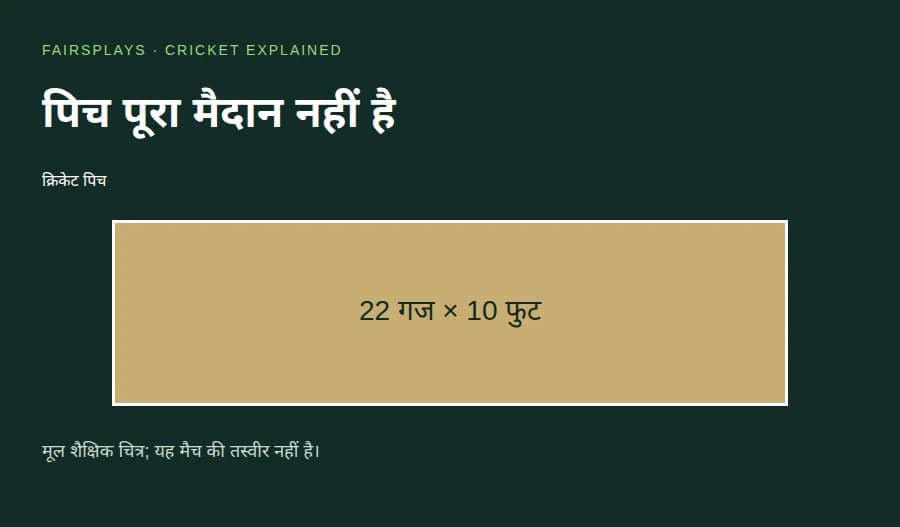
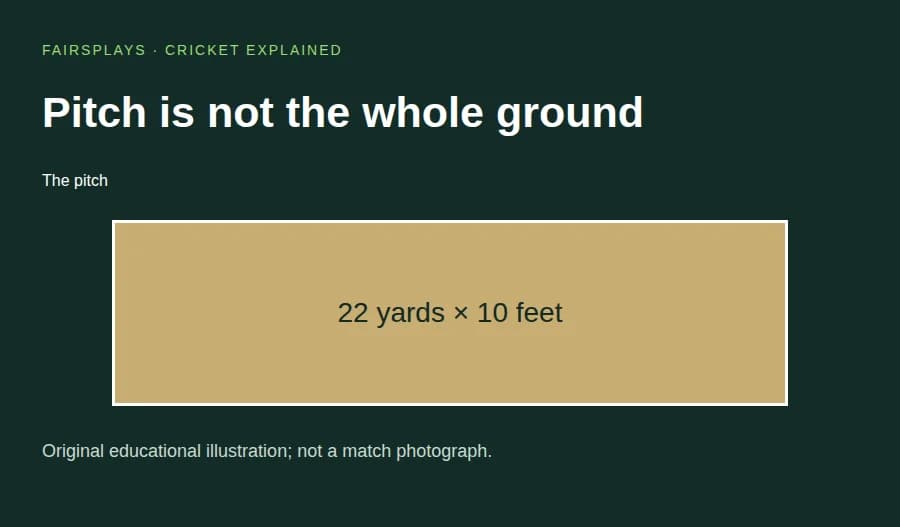
The cricket pitch is the marked rectangular strip used for bowling and batting; the cricket ground is the much larger playing area around it. The pitch contains the wickets and creases. The ground includes the pitch, outfield and field-of-play boundary. Under MCC Law 6, the pitch is 22 yards (20.12 metres) long and 10 feet (3.05 metres) wide. That is not the size of the whole stadium and does not set one universal boundary distance.
Boundary placement depends on the competition’s playing conditions, the venue and the umpires’ pre-match decision. The exact numbers below are therefore labelled by rule source and format rather than presented as a rule for every kind of cricket.
Key Takeaways - MCC Law 6 defines the pitch as 22 yards/20.12 m long and 10 ft/3.05 m wide. - Bowling, popping and return creases mark the wicket area and batter’s ground; they are not the stadium boundary. - The ground contains the pitch, outfield and field-of-play boundary. A rope or authorised equivalent usually marks that boundary. - Current ICC men’s ODI and T20I conditions use a scoped boundary range, with stated exceptions. Other formats and competitions can differ.
What is a cricket pitch?
The pitch is the central rectangular area where the ball is delivered and the batters make their runs. MCC Law 6.1 gives it a length of 22 yards (20.12 m) and a width of 10 feet (3.05 m). Its ends are marked by the bowling creases. Its sides are defined by imaginary lines parallel to the line joining the centres of the middle stumps, 5 feet (1.52 m) from that line.
These are legal dimensions, not a judgement that a surface is “good for batting” or “helpful for spin”. Bounce, pace, grass and turn are separate playing characteristics. The umpires assess fitness for play, while the ground authority prepares the surface.
What do the cricket creases mean?
MCC Law 7: The Creases identifies three main crease markings:
- Bowling crease: its back edge marks the end of the pitch and it is 8 ft 8 in (2.64 m) long.
- Popping crease: its back edge is 4 ft (1.22 m) in front of and parallel to the bowling crease. It extends at least 6 ft (1.83 m) on either side of the imaginary middle-stump line and is considered unlimited in length.
- Return creases: these meet the popping crease at right angles. Their inside edges are 4 ft 4 in (1.32 m) from the middle-stump line on either side. Each is marked at least 8 ft (2.44 m) behind the popping crease and is considered unlimited in length.
In simple terms, the bowling crease helps mark the pitch end, the popping crease is the main forward reference for the batter’s ground, and the return creases help define the side limits of the delivery area. A batter making ground is judged against the relevant crease, not against the rope around the outfield.
What is the cricket ground and boundary?
The ground is the complete playing setting. It contains the pitch and creases, the outfield and the field-of-play boundary. Beyond that boundary may be advertising boards, team areas and spectator facilities. Each stadium can have a different layout, and a nearby fence or sight-screen is not automatically the boundary.
For the men’s international limited-overs clauses linked below, the ICC says umpires determine the field-of-play boundary before the toss and keep it fixed for the match. The current men’s ODI and T20I conditions state that, measured from the centre of the pitch, no boundary should be longer than 90 yards (82.29 m) and no boundary should generally be shorter than 65 yards (59.43 m). The same provisions require a 3-yard (2.74 m) safety run-off between the boundary rope and the first solid object, with an exception process for an approved ground that cannot meet a minimum.
These are bounded conditions for the named men’s international formats, not a universal boundary measurement. The ICC playing-conditions index lists separate documents by format and event. The linked addendum also shows that women’s T20I provisions can use different figures in the stated circumstances, so a guide should name the applicable document.
A boundary is normally a rope or an authorised similar object. Where a grounded object marks it, the boundary is the edge nearest the pitch under the relevant ICC conditions. Umpires decide how obstacles and markers are treated before the toss.
How do venue pages fit into the picture?
A venue page can tell you which ground hosted matches and may list capacity, fixtures or historical scoring records. It does not replace MCC Laws or the applicable playing conditions, and it does not prove that every side of a stadium has the same measured distance. See FairPlay’s cricket stadiums in India, cricket venues hub and scorecard guide. Venue figures are not a measured boundary plan.
This article is a static rules explainer. It does not provide a live score, current pitch report or venue-specific boundary survey.
Frequently Asked Questions
Is every cricket boundary 65 or 90 yards?
No. Those figures come from the named ICC men’s ODI and T20I boundary conditions, measured from the centre of the pitch and subject to stated exceptions. Other formats, competitions and women’s provisions can differ.
Does the popping crease run only six feet wide?
No. MCC Law 7 requires it to extend at least 6 feet on either side of the middle-stump line and treats it as unlimited in length. The 6-foot figure is a minimum extension, not the full width of the ground.
Can the boundary move during a match?
Under the linked ICC men’s ODI and T20I conditions, umpires determine it before the toss and keep it fixed for the match. If a marker is disturbed, the conditions provide for restoring its original position.
Sources
- MCC Law 6: The Pitch
- MCC Law 7: The Creases
- ICC Men’s T20I Playing Conditions — October 2026
- ICC Men’s ODI Playing Conditions — October 2026
- ICC Men’s and Women’s T20I Playing Conditions Addendum
- ICC Playing Conditions index
This evergreen draft uses scoped rules language and contains no live-match result or venue-specific boundary claim. Approval and production validation remain pending.
Editorial review and approval: Mohini Yadav, Ajit Mohan Yadav and Rahul Jethalal.