 Mohini Yadav
 Ajit Mohan Yadav
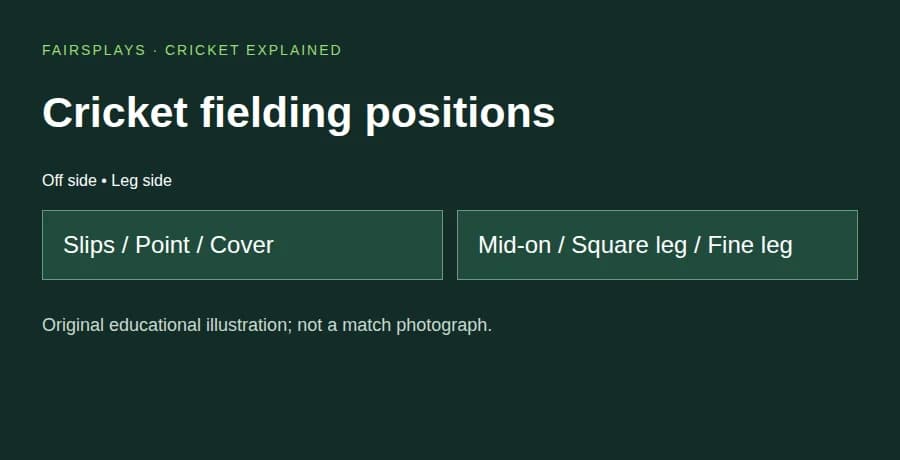
Cricket fielding positions are conventional areas named from the striker’s stance, the angle of the shot and the distance from the wicket. The off side is away from the batter’s legs; the leg side, also called the on side, is nearer the legs. Slip and gully are close catching areas, while point, cover, mid-off, square leg, fine leg and third man protect different angles. A fielding diagram explains the relationships, not a fixed formation for every delivery.
The reference point is the striker looking towards the bowler, not the television camera. The map also changes with handedness: a right-handed batter and a left-handed batter do not present the same off-side and leg-side geometry. MCC Appendix A provides the terminology, while MCC Law 28: The Fielder covers fielders’ conduct and restrictions.
Key Takeaways - Off side and leg/on side are defined from the striker’s batting stance; the practical map reverses for a left-handed batter. - Slip and gully are behind the wicket on the off side; point and cover are squarer or in front of square on that side. - Mid-off and mid-on are straighter positions, while square leg and fine leg are on the leg side and third man is behind square on the off side. - “Short” and “deep” describe relative distance from the batter. They do not name compulsory distances in the Laws. - Captains adjust the field for the batter’s handedness, the bowler’s angle, likely shots, pitch and match phase.
Off side and leg side: the starting point
Stand where the striker stands and look towards the bowler. In everyday cricket language, the off side is the side away from the batter’s legs. The leg side or on side is the side nearer the legs. This wording is intentionally stance-based: it is safer than describing the sides from a camera angle or from the boundary.
For a left-handed batter, the named areas appear on the opposite practical side compared with a right-handed batter. That does not mean the ground changes; it means the striker’s body position changes the reference. MCC Appendix A: definitions and explanations includes the official definitions and an off-side/on-side illustration.
Close catching positions: slip and gully
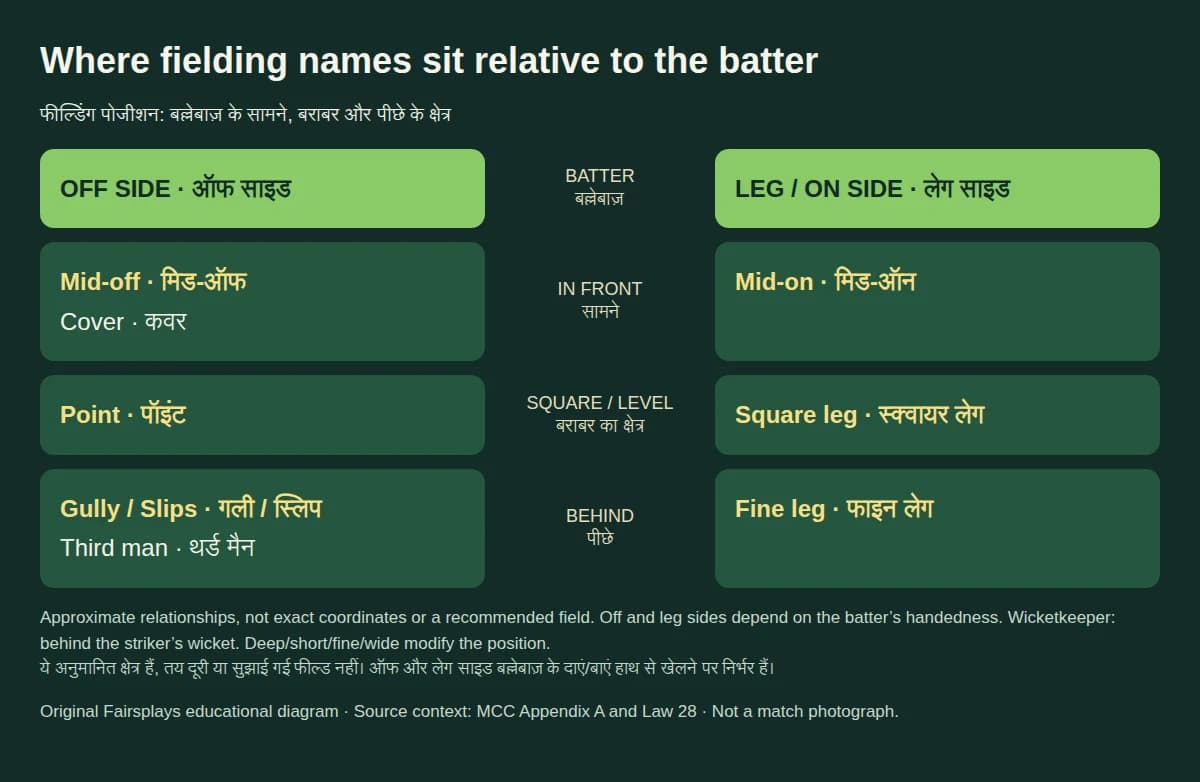
A slip stands beside the wicket-keeper, behind the striker’s wicket on the off side. One or more slips may be used to catch an outside edge. Slip is normally a close catching role; it is not automatically a boundary position.
Gully is wider and more square than slip. It covers edges and angled shots travelling between the slip cordon and point. A captain may use a short gully when the bowler is finding movement, but the exact placement depends on the plan and conditions. “Short” and “deep” are descriptive terms for distance from the bat, not separate mandatory positions in the MCC Laws.
MCC Law 28 regulates what fielders may do, including movement before the ball reaches the striker and limits on the on side. Competition playing conditions can add format-specific restrictions, so a learning map should not be read as a legal field-setting template. The ICC playing-conditions hub is the better source for a particular international competition.
Point and cover: the main off-side protection
Point is approximately square to the wicket on the off side. It reacts to cuts, square drives and mishits. A closer placement may be called short point; a deeper placement may be called deep point or a point boundary rider. Those labels describe a tactical area, not an exact coordinate.
Cover is in front of square on the off side, between point and mid-off. It protects the drive and can save a single through the infield. Extra cover is generally somewhat straighter towards mid-off, though the actual angle varies with the captain’s plan, the bowler’s line and the batter’s preferred shot.
In T20 cricket, the size and location of the permitted inner field can change by over. FairPlay’s powerplay, middle-overs and death-overs guide explains the phases, but no format makes every T20 field identical.
Mid-off, mid-on, square leg, fine leg and third man
Mid-off is a straighter off-side position in front of the wicket, nearer the bowler than cover, and often helps protect the straight drive. Mid-on is the matching straighter area on the leg side. Either can be brought in or sent back; “mid” identifies the general angle rather than a fixed distance.
Square leg is approximately square on the leg side. It is relevant to pulls, sweeps and glances and may be close for a catch or deep for boundary protection. Fine leg is behind square on the leg side, nearer the line behind the wicket-keeper, and can cover glances, deflections and fine edges.
Third man is behind square on the off side. In limited-overs cricket it is often near the boundary to protect edges and steered shots. The name identifies a region; it does not guarantee one distance from the wicket or boundary.
For a separate explanation of what appears on a scorecard, see FairPlay’s cricket scorecard guide. Fielding positions are tactical details and are not standard scorecard columns.
Why the field changes from ball to ball
There is no universal “correct” field. The captain may move a slip fielder to the boundary when the batter attacks, bring a short leg into play against a spinner, or protect a likely boundary area late in an innings. The decision can reflect handedness, bowling line and angle, pitch behaviour, batter tendencies and the match situation.
A fielding map therefore answers “What do these names generally mean?” It does not answer “Where will every fielder stand next?” International matches apply the MCC Laws together with the relevant ICC playing conditions. The captain must also respect restrictions on movement and on-side fielders under the applicable rules.
This is a static explainer, not a current field map, toss report or playing-XI prediction. For a current match state, use FairPlay’s live cricket scores separately.
Frequently Asked Questions
What is the difference between off side and leg side?
The off side is away from the striker’s legs and the leg/on side is nearer them. The striker’s stance is the reference, so the practical map reverses when a left-handed batter faces the bowler.
Is gully the same as slip?
No. Both are usually close catching areas behind the wicket on the off side, but gully is wider and more square than slip. Their precise depth can change with the bowler and batter.
Are fielding positions fixed by the Laws?
The names are conventional cricket terminology. The MCC Laws regulate fielders, movement and certain limits, while competition conditions can add restrictions. The diagram is an educational relationship map, not a compulsory formation.
Sources
- MCC, About the Laws of Cricket
- MCC, Appendix A: Definitions and explanations
- MCC, Law 28: The Fielder
- ICC, Playing Conditions
This evergreen draft contains no live-match claim, predicted XI, toss, result or trend claim. Approval and production validation remain pending.
Editorial review and approval: Mohini Yadav, Ajit Mohan Yadav and Rahul Jethalal.